Product Overview
Dicing is the step in meat processing machinery where portion size is actually fixed, and this machine does it in one pass: whole cuts go in through the top chute and come out as cubes, cuboids or strips, with no pre-cutting and no second machine behind it. It works cold, fresh and semi-thawed meat, which is the range the cutting head is designed around.
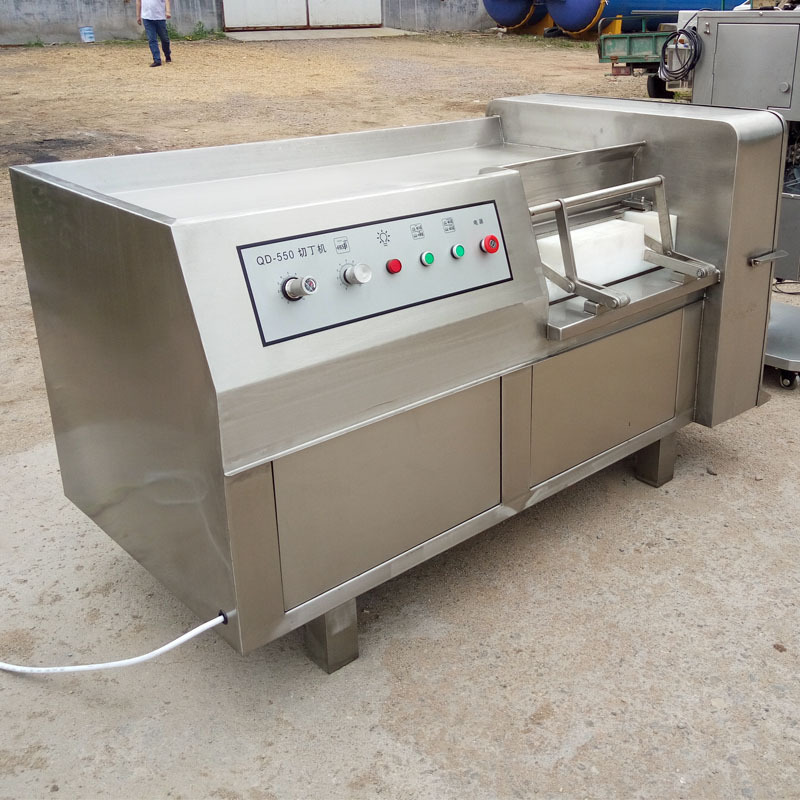
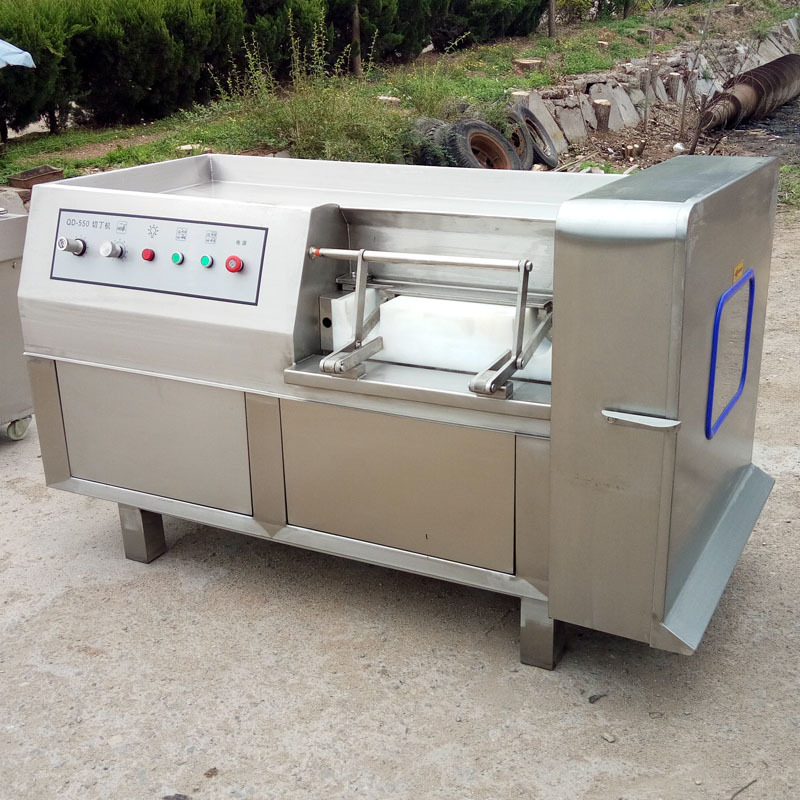
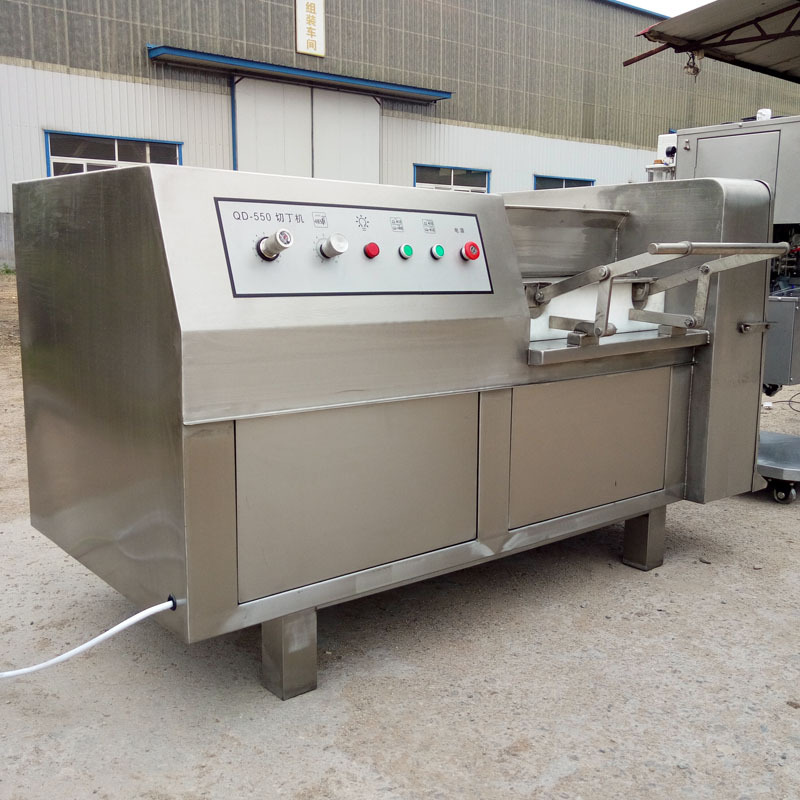
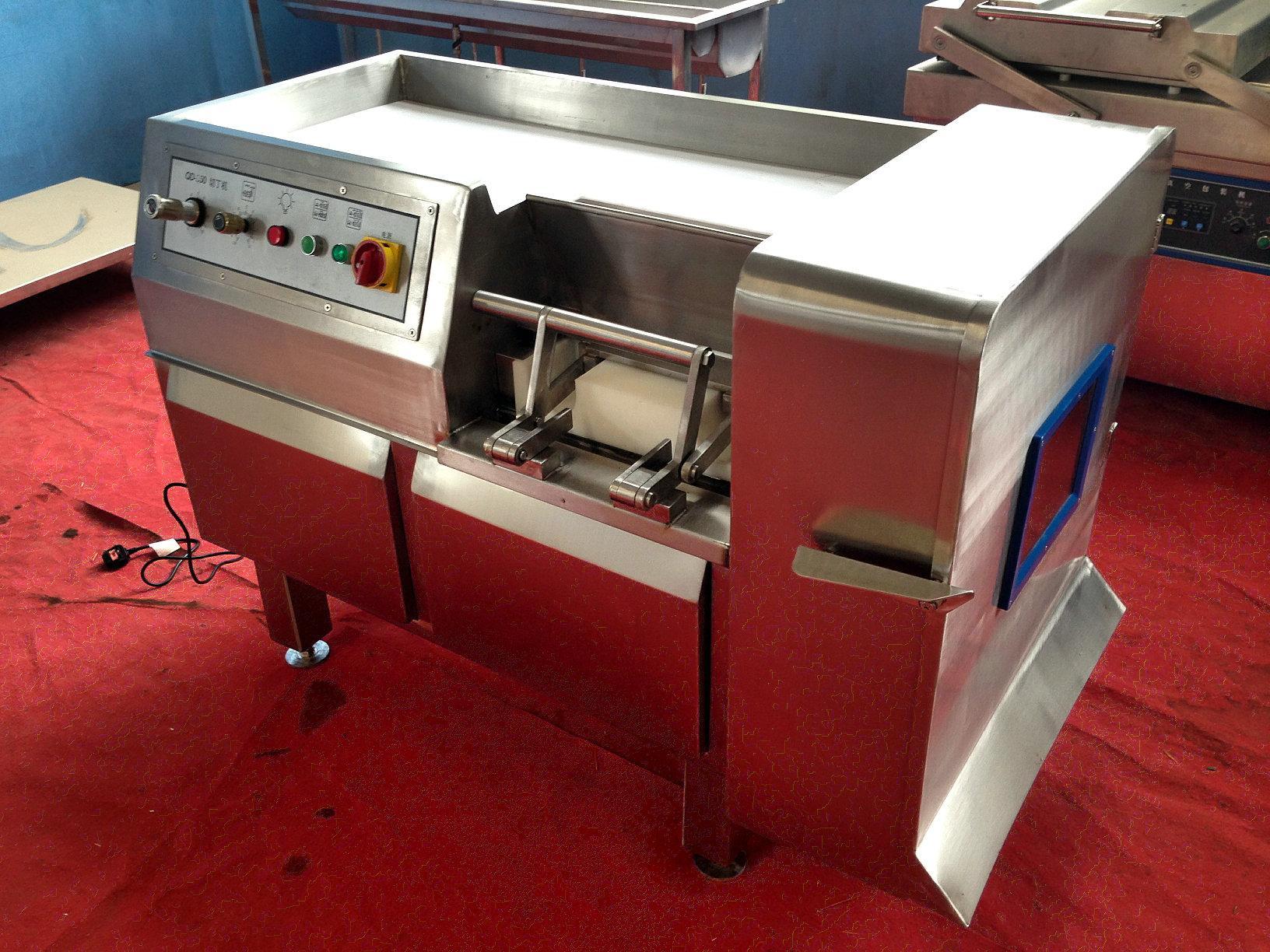
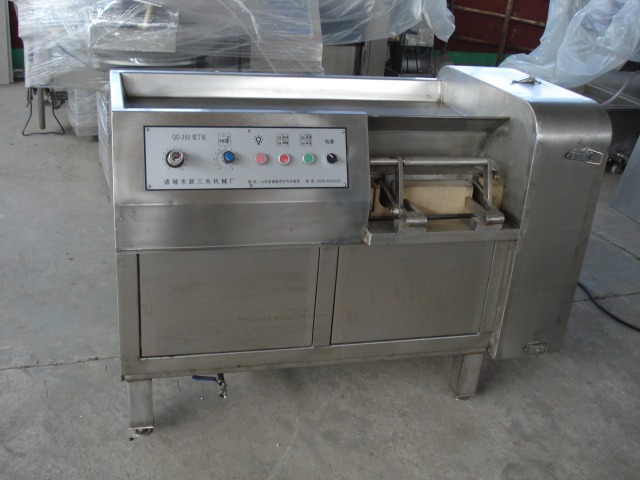
Two models share one design and differ in capacity and cutting width rather than in how they work. Both stand on a stainless steel frame, both load through an open top chute with a guard rail and a pusher, and both use interchangeable cutting grids, so changing product size means changing the grid rather than changing the machine.
Buyers are usually dicing rooms in meat plants, kebab and ready-meal producers, central kitchens supplying their own outlets, and butcheries that want one consistent cube instead of a hand-cut mix. In daily operation the operator loads prepared meat into the hopper, guides it forward with the pusher and collects finished pieces at the discharge; a size change is a grid swap with the head open — ask meat processing equipment suppliers to demonstrate that swap before you buy, not just the cutting stroke.
Key Features and Cut Quality
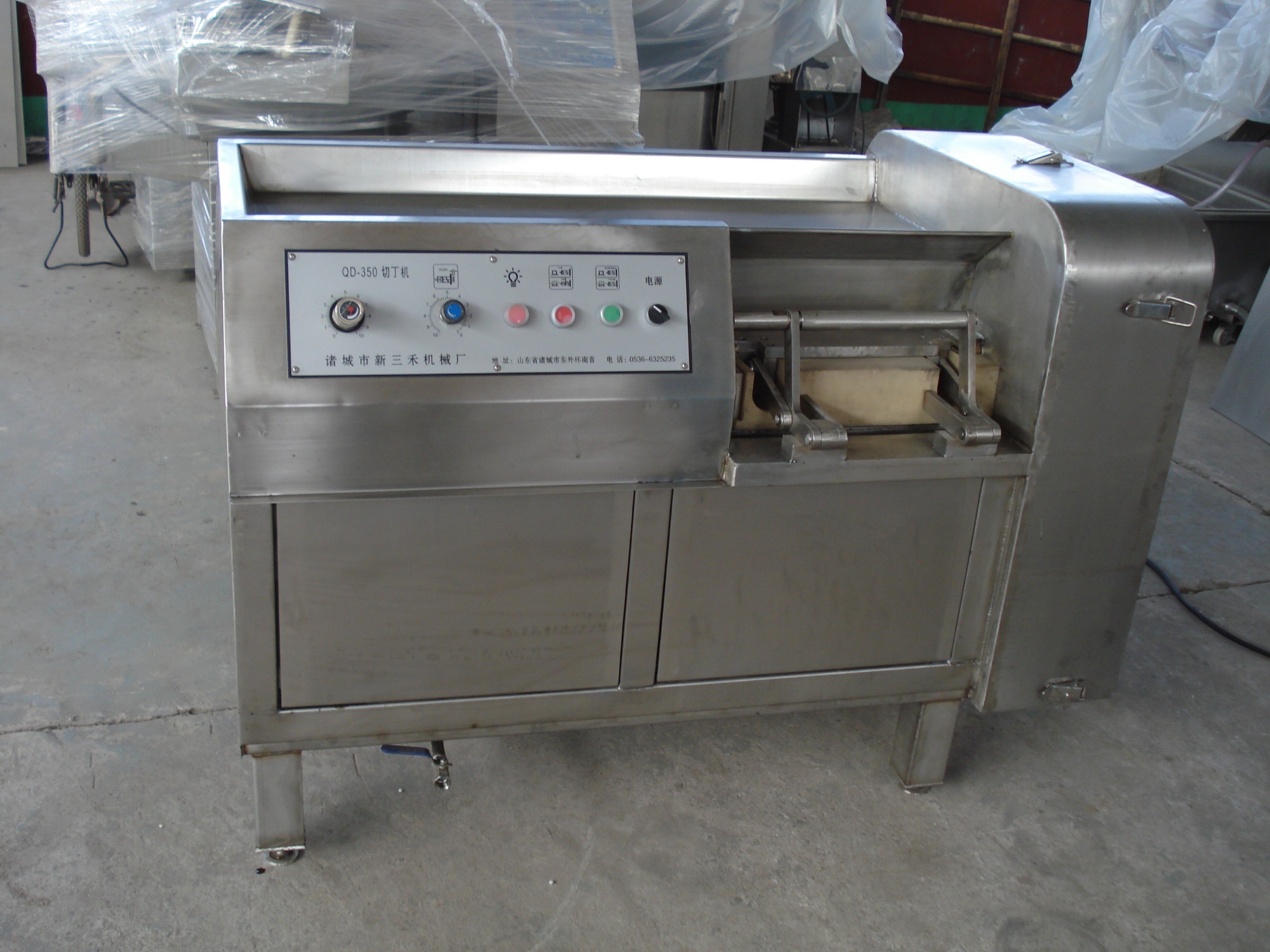
- Blade gap under 0.1 mm. The blades sit close enough that meat is separated rather than crushed, which keeps cube faces square instead of torn and keeps the inside of the piece looking fresh after a day in the chiller. - 1–2 mm of stock left after a stroke. Very little product is trapped in the head at the end of a run, so what you lose on a batch of expensive cuts stays small and the head clears quickly between products. - One stroke makes the whole piece. The grid sets the cross-section and the head sets the length, so a cube is finished in a single pass — no pre-sawing into strips and no second unit in the line. - Repeatable size across a shift. Size comes from the grid rather than from the operator's hand, so portion weight stays close from the first batch to the last and cooking times stay predictable. - Guarded feed with a pusher. A metal guard rail runs alongside the open top chute and a metal pusher guides product into the head, so hands stay behind the guard throughout the stroke. This machine is a good example of how a hand-fed unit should be laid out in commercial meat processing equipment — the guard and the pusher are the first things to check in any unit meat processing equipment suppliers show you.
Build, Cleaning and Care
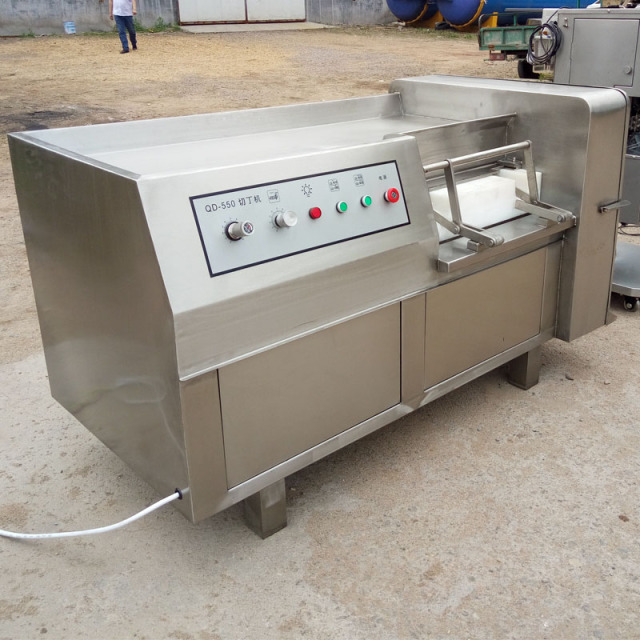
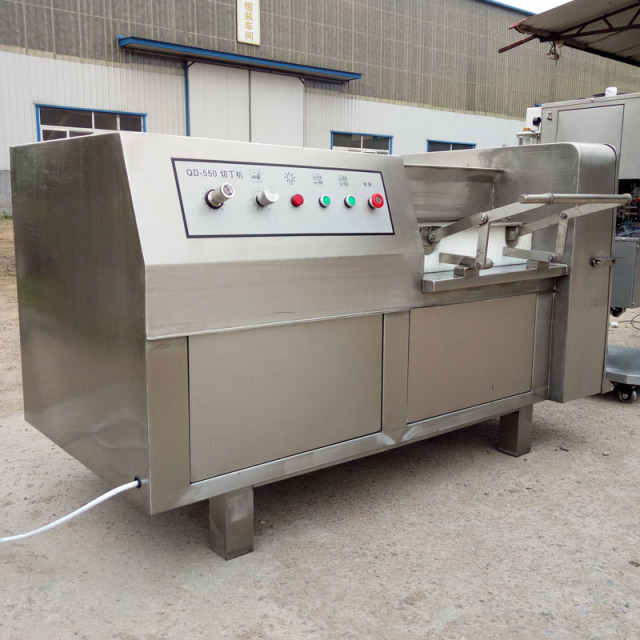
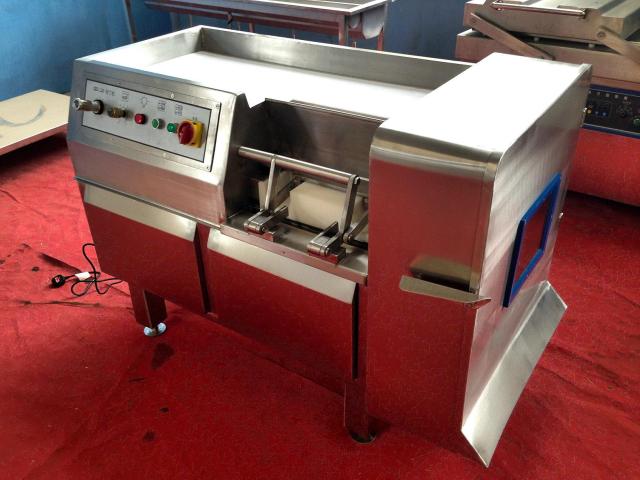
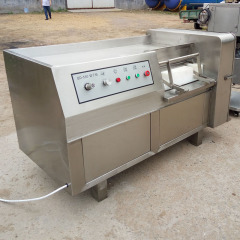
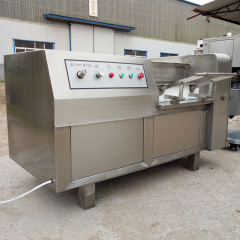
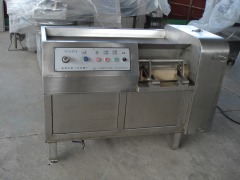
Stainless steel construction is the norm for meat processing machinery, and this machine follows it: the frame, the chute and the cutting head are all stainless, finished with a brushed surface that shows fat and residue rather than hiding it. The control panel is slanted towards the operator and carries rotary dials and push buttons, and the cabinet stands on four legs that leave the floor clear underneath for washing down.
The work happens at the grid and blade head, which is the part that has to come apart every day. The cutting block and the pusher lift out so the head can be brushed, rinsed and dried before the next product — a strip-down this quick is worth watching for when you compare meat processing equipment manufacturers, because a head that is awkward to open is the head that gets cleaned least.
Between products, a full head clean prevents carry-over of colour, fat and allergens from one batch to the next, which matters far more to a plant running chicken and beef on the same shift than to one running a single product. A light food-grade oil on the moving parts at the intervals given in the manual, with a look at blade condition at the same time, will catch a dull or chipped edge before it starts tearing cubes. Keep one spare grid in the size you run most and one spare set of blades on the shelf; a worn edge is the commonest cause of a sudden drop in cut quality, and having the parts on site turns a lost day into a lost hour.
Meat Preparation and Thawing
This machine is often bought as a frozen meat dicer, so the limit needs saying plainly: it does not cut meat straight out of a −18 °C freezer. Blocks at that temperature are hard enough to load the head badly, and the cut faces shatter rather than separating cleanly.
The working method is to temper the meat in a thawing tank to around −5 °C — firm enough to hold its shape under the grid, soft enough to cut. Depending on block size and water temperature that takes a few minutes to about ten minutes. Plan this stage into the shift, because a dicer rated at several hundred kilos an hour is only as fast as the thawing in front of it, and a queue of still-frozen blocks is the usual reason a dicing line underperforms. It is also the point worth pressing hardest when you compare meat processing equipment suppliers, since a capacity figure assumes prepared meat at the chute.
Meat that has come all the way up to room temperature is the opposite problem: it compresses under the pusher, smears at the blade and gives cubes with rounded edges. Between those two extremes there is a wide working window, and most plants find it quickly once they run their own product through. If your operation only ever holds hard-frozen stock, say so before ordering — a different cutting setup will serve you better than a dicer run outside its range.
Installation and Start-Up
- Before the crate is opened, walk the route from the door to the machine's position and check the clearance — moving meat processing machinery after it is in place is far harder than measuring a doorway first.
- Stand the machine on a level, load-bearing floor with space at the feed end for the operator and at the discharge end for the collection tub, and check that the floor underneath can be reached for washing.
- Chock or bolt the feet so the frame cannot walk under vibration, then confirm that nothing blocks the head from opening fully for cleaning.
- Have an electrician connect the supply against the rating on the machine's nameplate, with the correct phase and a proper earth; if your site voltage or phase differs from the standard configuration, confirm it with us before the machine ships rather than after it lands.
- With the power off, check that the head turns freely by hand, that the grid seats squarely and that the pusher and guard rail move as they should.
- Run the machine empty for a short check of rotation direction and control response, then run a small batch of properly tempered meat through, check the cube against your specification, and only then bring the line up to full feed rate. Train every operator on the grid change and the guard before the first production shift.
Applications
- Ready-meal and tray-packing lines. Portion consistency starts at the dicer: cubes that weigh the same hold the tray count and the cooking time steady, which is why tray packers put a dicer rather than a chopper into their commercial meat processing equipment.
- Kebab, skewer and grill production. Cube and strip work come off the same head, so a skewer line stays supplied without a second machine, and the clean faces hold a marinade without breaking down.
- Central kitchens and chain restaurants. A kitchen dicing beef, chicken or pork for several outlets replaces a bench of hand-cutters and gets the same cube in every site's portion.
- Butcheries and meat shops. Diced beef and pork for the counter, pre-packed stew packs and stir-fry strips come off one unit, with the grid changed between products.
- Sausage, burger and further-processing plants. A fine dice for filler and a coarse dice for texture come from the same machine, so a recipe change is a grid change rather than a new purchase.
- Tofu and other firm non-meat products. Freshly baked tofu blocks dice cleanly on the same head, which makes the machine useful to vegetarian and mixed-product lines as well as meat plants.
Specifications
| Model | PH-350 | PH-550 |
|---|
| Capacity | 500–700 kg/h | 700–900 kg/h |
| Power | 1.5 kW + 0.75 kW | 2.2 kW + 1.5 kW |
| Cutting grid size | 4, 5, 6, 7, 8, 9, 11, 13, 16, 20, 27 mm | 4, 5, 6, 7, 8, 9, 12, 16, 24, 30 mm |
| Cutting groove size | 84 × 84 × 350 mm | 120 × 120 × 550 mm |
| Overall dimensions | 1480 × 800 × 980 mm | 1940 × 980 × 1100 mm |
| Weight | 500 kg | 700 kg |
| Cut shapes | Cubes, cuboids, strips | Cubes, cuboids, strips |
| Piece size range | 2–100 mm | 2–100 mm |
| Strip length | Up to 80 mm | Up to 80 mm |
Model Selection
The two models differ in capacity, cutting width and grid range, not in principle. Choose the smaller one when dicing is one step among several in a room that also runs mincing, packing or cooking and the dicer stands idle between batches: its footprint fits a tighter room and its motor load is easier on a modest supply. Choose the larger one when dicing sets the pace — a line feeding a continuous stuffer, a tray-packing line, or a second shift — because the extra width absorbs the peaks instead of pushing them into overtime.
If your weekly volume sits between the two, buy for the busiest week of the year rather than the average one. The smaller model cannot be widened later, whereas the larger one can simply be run below capacity. Buyers comparing meat processing equipment manufacturers often fix on the capacity figure and stop there, but the number that usually decides the model is the biggest cube they sell, because only the larger unit reaches the widest grids.
Physical fit matters as much as output: the bigger frame needs more clear floor at the feed and discharge ends and a firmer floor under its feet. Where a product mix runs through several sizes, count the grids you will actually change between and add them to the same order.
Cut Sizes and Grid Options
- Small grids for fine work. The tightest openings give a small, even dice for sausage filler, pizza topping, dumpling filling and ready-meal garnish, where the cube has to disappear into the mix rather than sit on top of it.
- Mid-range grids for the everyday cuts. Stew, kebab, curry and casserole cubes come from the middle of the range; most plants run two or three of these sizes as standard and keep those grids on a shelf beside the machine.
- Large grids for chunky products. Goulash, pie filling and traditional diced beef for pre-packed trays come from the widest openings, and only the higher-capacity model reaches them.
- Strips as a second product. The head also runs strip work, so jerky, stir-fry and skewer lines can be served from the same unit as the cube business.
- Match the grid to the cut, not to the ruler. Meat shrinks and relaxes during cooking, so a cube ordered at one size may need the next grid up to look right on the plate once it is cooked down. Test with your own product before you fix a specification.
- Plan the grid set with the order. A dicer is only as flexible as the grids beside it, and most buyers build the two or three sizes they run weekly into the same meat processing equipment order so a size change never waits on a delivery.
Ordering and Delivery
- Fix the model and the grid set first. Tell us the products you dice, the sizes you sell and your busiest week, and confirm which grids come with the unit and which you are adding.
- Confirm the electrical supply. Voltage, phase and plug standard vary by market, so confirm your site's supply before the machine is configured; changing it afterwards is far more expensive than specifying it up front.
- Price and terms. Indicative FOB pricing for a single set runs from about US$4,000 to US$8,000 depending on model and grid configuration — ask for a firm figure against your specification.
- Payment. T/T, Western Union, MoneyGram and PayPal are all accepted, so confirm which route suits your finance team and what deposit arrangement applies to your order.
- Shipping. Machines ship from Shanghai or Qingdao; give us the destination port so freight and insurance can be quoted together, and confirm the crate dimensions before you book inland transport or lifting equipment.
- Availability and documents. Monthly supply runs to around 100 sets, but confirm the slot for your build and the lead time for any extra grids at the same time. Ask what accompanies the shipment — packing list, manual, parts list — so nothing is missing on arrival.
- A specification sheet covering both models sits with this product and can be downloaded for your files. It is the version to send to a maintenance team or to an importer who is comparing meat processing equipment manufacturers and wants the numbers side by side on one page rather than spread across a conversation. Beyond that sheet, a machine of this type normally travels with an operation manual covering the grid change, the cleaning routine and the lubrication points, together with a spare-parts list that names the blades, the grids and the seals. If you need any of these as a PDF before you commit, or a copy of the pre-shipment inspection record for your own quality file, ask when you enquire and we will send what is available for your configuration. Buyers importing into Europe or North America often need the manual and the nameplate data in a particular form for their own documentation. Tell your sales contact what your file has to contain and it can be checked before the machine is packed, which is much easier than chasing paperwork after it has sailed.
Technical Support & Model Matching
Tell us your output, product size and local voltage, and our technical team will match you to the right model from the manufacturers in our supply network. We have been sourcing food processing machinery since 2017 for buyers across Europe, North America and beyond. Before shipment we confirm configuration and any light OEM or ODM requirements; after delivery we stay with you through installation and commissioning guidance, operator training, fault diagnosis and spare-part support, with a 7×24 response line.
FAQ
Will it dice bone-in chicken or ribs?
No. This machine is built for boneless meat — cubes, cuboids and strips — and bone sits outside its working range, both for the blade gap and for the load it puts on the head. Bone-in chicken, ribs and small bony cuts are handled by a cutting machine with a heavier blade setup, which is a different machine for a different step. Tell us the cuts you handle and whether they arrive chilled, tempered or frozen, and we will say which machine each product belongs on.
How long does it take to change from one cube size to another?
Size comes from the cutting grid rather than from a setting on the panel, so the change is a physical swap: the machine stops, the head opens, the grid lifts out and the next one seats in its place. It is an operator job at the machine rather than a technician job, and plants running two or three sizes a shift usually learn it at handover and keep the spare grids within reach. Ask us to walk your operators through the sequence during commissioning so everyone learns it the same way.
Can it handle marinated, salted or high-fat mixes?
The rated working range is cold, fresh and semi-thawed meat, and that is where the machine behaves predictably. Marinades, salt and a high fat content all change how product feeds into the head and how cleanly it releases from the grid: some mixes run well, others smear. Because the behaviour depends on your recipe rather than on the machine, ask your sales contact whether a sample can be tested in the condition it would reach the dicer, and we can advise on the grid that suits before you commit to a specification.
What is the difference between this and a bowl chopper or a grinder?
A chopper or a grinder breaks meat down — it minces, emulsifies or cuts at random, and the result is a mass rather than a shape. A dicer cuts defined cubes with clean faces, so the piece keeps its identity through marinating, cooking and packing. That difference decides the application: stew, kebab, jerky, pizza topping and ready-meal portions need a cube that still looks like a cube on the plate, which is why a dicer rather than a chopper sits at that point in most meat processing equipment layouts.
Can it run at its rated capacity for a whole shift?
The capacity figures assume a steady feed of prepared meat, and that is where most lines lose output. Throughput falls when the hopper is loaded in bursts, when pieces arrive too large for the chute and have to be cut down by hand, or when one operator is expected to load, change tubs and pack at the same time. Two people on the feed end during peak hours will get more out of the machine than any adjustment to the head. Tell us your shift pattern and target weight when you enquire so we can say which of the two models leaves you headroom.