Croissant Rolling Machine — Automatic Croissant Molding & Shaping Machine (PH-240)
Description
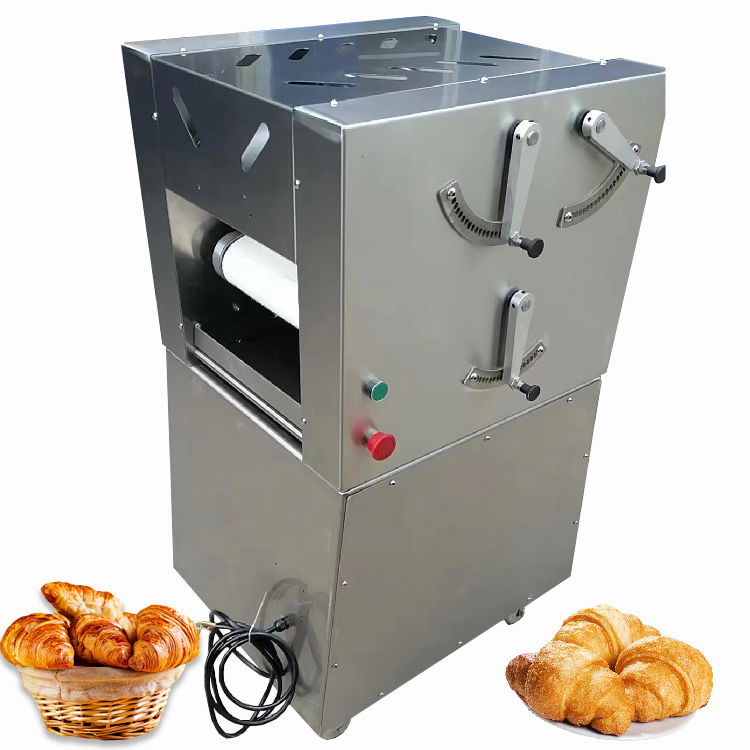
The croissant molding machine can quickly shape croissants and similar products by placing the triangles of the dough on a dedicated conveyor belt. Operation instructions for the croissant shaping machine: It can quickly form croissants and similar products by placing triangular dough on a dedicated conveyor belt. The rotation of the active roller drives the conveyor belt to rotate in the direction of the pressure roller. The dough enters from the direction of the driven roller and passes through the pressure roller. The dough is driven by the belt to continue moving forward. The upper end of the dough first comes into contact with the formed sheet, causing the front end of the dough to roll up backwards into a roll shape. During the forming process of the dough into sheep horn or cow horn bags, it is rolled up into a rod shape. After forming, the rod shaped dough is discharged from the discharge port and falls onto the receiving plate, which can be operated by a single person on one side.
Specification
|
Model
|
PH-240
|
|
Voltage
|
220/380v, 50Hz
|
|
Power
|
0.55kw
|
|
Belt width
|
240/260mm
|
|
Dimension
|
820*580*1080mm
|
|
Weight
|
100kg
|
|
Packing size
|
870*620*1230mm
|
|
Packing weight
|
120kg
|
|
Package
|
Standard Wooden Case
|
Key Product Features
Fully automatic rolling mechanism with consistent, professional results.
The machine works through a simple and reliable mechanical principle: the rotation of the active roller drives the conveyor belt toward the pressure roller; dough enters from the driven-roller side and passes through the pressure roller, after which the belt carries it forward. As the upper end of the dough first contacts the forming sheet, the front end automatically rolls backwards into a neat spiral — exactly the motion of a skilled baker's hands. Whether forming classic croissants, sheep-horn or cow-horn style pastries, every piece is rolled into a uniform rod shape with even tension and the same number of turns, so the layered butter structure is preserved and the baked result is consistent batch after batch — something hand rolling can never guarantee across different shifts and skill levels.
High efficiency that replaces manual hand rolling with a single operator.
Because the dough is formed automatically and discharged onto the receiving plate at the end of the line, one person on one side of the machine can feed and collect continuously without needing skilled labor at the rolling bench. This saves the time, training cost, and inconsistency of manual rolling, and lets even a small bakery multiply its croissant output without expanding its workforce — the dough-side operation is simple enough for any new employee to master in minutes.
Compact, energy-saving, and easy to integrate into any line.
At just 0.55 kW (220V/380V, 50Hz), the PH-240 consumes very little power while running continuously. It measures only 820 × 580 × 1080 mm and weighs 100 kg (packed: 870 × 620 × 1230 mm, 120 kg), so it fits into tight workshops, can be moved between production areas, and needs no special foundation or civil works. The belt width is selectable between 240 mm and 260 mm, letting you match the conveyor to different dough sizes and recipe weights, and the receiving plate collects finished pieces neatly for immediate proofing or freezing.
Application Scenarios
Bakery production lines and central kitchens producing croissants at volume.
For bakeries, central kitchens, and frozen-dough plants that turn out croissants and puff-pastry products by the thousand, hand rolling is the classic bottleneck: slow, labor-hungry, and hard to keep uniform. The PH-240 sits at the heart of such a line — triangular dough cut from the sheeter is fed onto the belt, rolled automatically, and discharged ready for proofing, baking, or blast-freezing. It is especially valuable for frozen semi-finished croissant programs, where every piece must be identical in shape and roll structure so that retail customers can proof and bake them with predictable results.
Independent bakeries, artisan shops, and chain bakery stores.
For a storefront bakery, croissant demand often peaks in the early morning, exactly when skilled bakers are busiest. The machine lets a shop pre-form a large batch of croissants quickly, freeing the baker for dough mixing, finishing, and oven work, while guaranteeing that every croissant from the case has the same elegant spiral shape customers expect. Because operation is so simple, it also removes the dependency on a highly skilled roller — new staff can produce at the same standard from day one, which matters for chains that need consistent quality across multiple stores.
Multi-product pastry workshops and food-service suppliers.
Beyond classic croissants, the machine forms sheep-horn and cow-horn style pastries and similar rolled products from triangular dough, making it a flexible tool for bakeries that produce several laminated-dough items from one dough family. Cafés, hotels, catering suppliers, and convenience-store bakery suppliers can all use it to standardize their pastry output, and the compact footprint means even a small production room can add a mechanical forming station without rearranging the whole workshop.
FAQ
Q1: How does this croissant rolling machine work?
A: Place triangular dough pieces on the dedicated conveyor belt. The active roller drives the belt toward the pressure roller; the dough passes the roller and its upper end contacts the forming sheet, which rolls the front end backwards automatically into a croissant rod. The finished piece is discharged onto the receiving plate.
Q2: What is the capacity?
A: The PH-240 is designed for continuous one-person operation — feeding and collecting continuously on one side of the machine. Exact pieces per hour depend on dough size and operator feeding pace; please confirm your target output with our engineer.
Q3: What products can it form?
A: Classic croissants, sheep-horn (羊角包) and cow-horn (牛角包) pastries, and similar rolled products made from triangular laminated dough.
Q4: How much space and power does it need?
A: Only 820 × 580 × 1080 mm and 0.55 kW (220V/380V, 50Hz). It needs no special foundation and can be moved between work areas.
Q5: Can I choose the belt width?
A: Yes. The belt width is selectable between 240 mm and 260 mm to match different dough sizes.


